
Accepting submissions
Not accepting submissions
See https://hasgeek.com/rustbangalore/cfp-rust-india-conference-2026/ for submission guidelines.

Vaishnav Sabari Girish AlertAngel: A device to make monitoring Elderly Patients a breezeAlertAngel is an elderly-care monitoring system that provides real-time health tracking, fall detection, and instant alerts for caregivers. more
Session type: 30 mins talk
|

Navdeep Agarwal MJ
Mayur Jadhav Big Data Analytics on Tiny MachinesCFP: Big Data Analytics on Tiny Machines Talk Title more
Session type: 30 mins talk
|
|
As
Akash soni 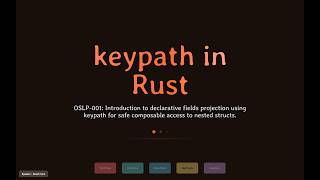 Introduction to Functional RustDeclerative style of coding where we focus on what over how. Also going to explain how Key paths provide a safe, composable way to access and modify nested data in Rust. Inspired by KeyPath and Functional Lenses system, this feature rich crate lets you work with struct fields and enum variants as first-class values. more
Session type: 30 mins talk
|
|
IB
Ishan Bhanuka Over 6M records per second: Building data streaming logic for Nautilus trading engineAbstract Trading systems replay hundreds of GBs to test trading strategies. The data streaming layer plays a key role in reading data from storage in a correct, fast and efficient way. A good data streaming layer is the difference between being able to backtest hundreds of strategies vs a few handful. more
Session type: 30 mins talk
|
|
RS
Ravi Sawlani The Web, Rewritten in RustOne language, front to back — with memory safety and no regrets. more
Session type: 30 mins talk
|
|
AT
Abhinav Tripathi Wanted to Know Tokio So I Built My OwnTalk Description: The session will be a deep dive into the internals of how the Tokio crate implements its multi-threaded scheduler using Rust’s low level primitives, the reactor using OS syscalls and the task state machine using atomic state transitions. It will cover my learnings from writing a multi -threaded asynchronous runtime using the MIO crate (the same crate that tokio uses). more
Session type: 30 mins talk
|
|
D
Divya LLM meets FFI: Rust Bindings for C++ at Scale 🦀Integrating Rust into large C++ codebases often requires safe, idiomatic wrappers. This talk explores using LLMs to draft C++ shim layers and Rust FFI bindings. It highlights where AI accelerates boilerplate, where it fails on ownership and safety, and how to review generated bindings to avoid unsoundness and undefined behaviour. more
Session type: 30 mins talk
|
|
BB
Bhavya Bhatt Rust at Every Layer: Compiler, WASM, Vector DB, and a Blockchain — One Language to Rule Them AllTalk Preview At Weilliptic, we didn’t just pick Rust for one part of our stack — we bet the entire platform on it. WeilChain is an operating system for autonomous AI, running across clouds, and every critical layer of it is written in Rust. In this talk, I’ll walk through six distinct systems we built in Rust: the WIDL compiler (our interface definition language toolchain), the Icarus chatbot LLM… more
Session type: 30 mins talk
|
|
a
abhinav Rust is Safe, But Is It Fast? A Performance Reality Check Against C++Session Description Rust is often described as a systems language that gives you memory safety without losing the performance of C or C++. more
Session type: 30 mins talk
|

Devdutt Shenoi Get your Agents talking: an introduction of tower-a2atower, the has been a life changing tool in my developer toolset, especially given it’s ergonomic and composable nature. Recently I had the privilege of implementing a tower based library implementing the A2A protocol. In this short lightning talk, I intend to introduce the library and share with the crowd my learnings from building and using it. more
Session type: 5 mins flash talk
|

Srihari CocoIndex: incrementally processing data with a Rust core and a Python faceSession description CocoIndex is a framework for data pipelines that stay in sync with their sources without reprocessing everything on every run. The engine tracks what changed across runs, skips what hasn’t, and applies only the necessary updates. From the outside, writing pipelines looks like Python. You declare target states and the runtime handles the rest. The engine doing that work is Rust… more
Session type: 30 mins talk
|

Swanand Compiling Rust at Scale: Lessons from FelderaDraft slides [ please ignore the formatting, just draft for content ] more
Session type: 30 mins talk
|
|
RG
Raj Gandhi Writing a 3D Point-Cloud Library in RustTALK PREVIEW Point clouds are widely used in robotics, mapping, and 3D scanning. Most of the tools for working with them are written in C++, which can make development harder due to manual memory management and complex build systems. I started building threecrate, a Rust library for point-cloud and mesh processing, to explore whether Rust could offer a cleaner and safer foundation for this kind o… more
Session type: 30 mins talk
|
|
GS
Gaurav Sharma Rust Inside, Python Outside: Building a Blazing-Fast Driver SDK for Bulk Data IngestionAbstract Most database drivers pay a hidden tax on every row: Python value to driver object, driver object to protocol format, protocol format to packet, packet to network. Each conversion adds latency and memory pressure that compounds under bulk workloads. In this session, I show how the Microsoft Azure SQL Drivers team built a Rust-Native direct-to-wire BulkCopy path that eliminates this multi… more
Session type: 30 mins talk
|

Kumar Anirudha From Runtimes to ToolchainsBuilding a WASM ecosystem in Rust WebAssembly has matured from a portable binary format into a serious runtime target, but most discussions stop at individual runtimes. This talk explores what it actually takes to build a WebAssembly ecosystem, from execution engines to language toolchains, plugins, and shared distribution infrastructure, using Rust as the foundation. more
Session type: 30 mins talk
|
|
UK
Utsav Krishna Parse, Validate, Serialize: A Production Serde Round-Trip Across WASM and gRPC in Automotive Configuration ToolAbstract: In automotive software development, a misconfigured ECU parameter doesn’t cause a crash in staging. It causes unexpected behaviour in a vehicle. The tooling that handles configuration correctness needs to be held to the same standard as the software it configures. more
Session type: 30 mins talk
|
|
VC
Vikas Chahar Building an AI-Native Revenue Automation Platform with Rust MicroservicesAt Fourbyfour, we built an AI-native revenue automation platform from scratch using Rust microservices. This talk walks through our architecture: Gateway, Stream, Notifications, Hooks, Workflows, Attribution, Timer, and In-App services—all orchestrated to transform simple track() events into intelligent, auto-optimized notifications that recover revenue. I’ll share real lessons from production: i… more
Session type: 30 mins talk
|
|
SP
Shobhit Pandey Rust and Quantum CompilationQuantum computing has rapidly evolved over the past decade, moving from small qubit experiments in research labs to credible claims of computational advantage leveraging quantum systems, that are available to developers worldwide via cloud. Qiskit is an open-source quantum SDK, with its core performant components written in Rust, and is adopted by 70% of the quantum ecosystem according to communi… more
Session type: Hands-on workshop (2-3 hours)
|
|
R
Raman RailSim using RustAbout the project This project is a railway simulator made with Rust. The backend simulation logic uses rust for the signalling logic, rail pathfinding logic and the network state calculation. We are also using Bevy(https://bevy.org/) which a new rust based game engine for visualising the simulations. more
Session type: 30 mins talk
|
SuperTOML - adding type-safety and cascading configurations to TOMLSession Description TOML configuration usually starts off simple, but it doesn’t stay that way for long. As systems grow, you end up dealing with multiple environments, tenants, rollouts, and context-specific overrides. At that point, plain TOML starts to fall short—you either duplicate configs everywhere or move a lot of logic into your application code, which becomes hard to reason about and ma… more
Session type: 30 mins talk
|
|
AM
Aniket Mishra Formally Specifying the Rust CoreA number of Rust projects rely on the SIMD intrinsics provided by core::arch for performance. This includes libraries like hashbrown that are used in HashMap, as well as third-party cryptographic libraries like libcrux and Dalek that are used in mainstream software projects. However, the SIMD intrinsics in Rust lack documentation and are easy to misuse, and so even the best Rust programmers need … more
Session type: 30 mins talk
|
|
RK
Rahul K Building Durable Execution systems for Micro Service Orchestration using RestateWhat is my Session about? I will be talking about my browser session orchestrator implemented in Rust that prioritizes durability and explicit state management over traditional stateless request handling. This orchestration pattern can pretty much be applied to any api based execution systems. The system uses Restate as the core orchestration engine, allowing worker and session state to be persis… more
Session type: 30 mins talk
|

Ashutosh Pandey Is Rust the best language for LLM generated systems programming?Abstract Now that LLMs are capable of generating working code in pretty much any programming language, it raises the question of which language to use? Is an LLM equally good at generating safe C code versus Rust? Which language helps LLMs correct themselves the best? more
Session type: 5 mins flash talk
|
|
KT
Kasturi T Fearless Migrations and good User Experience{The Problem: In the world of infrastructure, “migration” is often a dirty word. At Nutanix, we realized that the primary barrier to adopting our modern platform, Prism Central, wasn’t a lack of features—it was the “migration tax.” Users were tethered to legacy Protection Domains because the path to the new system was a manual, error-prone minefield. For an SRE, a manual migration isn’t just a ch… more
Session type: 30 mins talk
|
|
RK
RamaChaitanya Kandula NIC topology and placement for AI: a Rust tool for faster distributed training.Distributed AI training runs over RDMA and depends on each GPU using the right NIC. When the scheduler assigns a rank to a NIC that isn’t the best for that GPU (e.g. cross-NUMA or extra PCIe hops), you can lose 20–40% throughput or see unstable runs. Most cluster schedulers don’t understand PCIe/NUMA topology, so we need a small, reliable tool that discovers how NICs and GPUs are connected and ou… more
Session type: 30 mins talk
|
|
Dg
Deval gupta Beyond Memory Safety: Making Binaries Hard to UnderstandSession Description Rust is heavily used to create fast and reliable systems, but despite all the guarantees that Rust makes on memory safety, it does not prevent reverse engineering of compiled code. Today’s tools can analyze optimized binaries, so it is essential to explore techniques that go beyond language-level guarantees. more
Session type: 30 mins talk
|
Code That Writes Code: Procedural Macros in RustOverview: Procedural macros in Rust enable developers to extend the language by writing code that runs during compilation to generate other Rust code. In other words, they consume an AST to produce another AST. Unlike declarative macros based on pattern matching, procedural macros operate on token streams and can perform transformations before the compiler proceeds. This makes them useful for red… more
Session type: 30 mins talk
|
GPU Programming in Rust with WgpuGPU programming has reached a state where developers are forced into vendor-specific ecosystems: CUDA for NVIDIA, Metal for Apple, DX12 for Windows, with minimal portability between them. WebGPU unifies this as a GPU API that targets Vulkan, DX12, and Metal as backends. wgpu is the Rust implementation of WebGPU, acting as the translation layer between your code and the underlying platform APIs. T… more
Session type: 30 mins talk
|
|
DD
Druva Dhakshinamoorthy Performance as the Default in OLAP EnginesIntroduction (5 mins) Case study: where we hit Java’s performance wall in our OLAP engine more
Session type: 30 mins talk
|
|
SB
Shivani Bhardwaj A network security project's journey with RustDescription Suricata[0] is a leading new-age, open source, Intrusion Detection and Prevention System which offers reliable and fast network traffic inspection and rich configurable logs. The availability of advanced features, configuration, hardware acceleration, standard JSON logs has led to a fast pick-up and popularity for this project. Given that Suricata’s focus is security, the first target… more
Session type: 30 mins talk
|
|
MK
Madhur Kumar 
Kamini Banait Debugging Rust Modules in the Linux KernelOverview: While Rust is now integrated into the Linux kernel, the process for debugging Rust modules remains poorly documented compared to C. This talk provides a practical guide to using GDB for kernel-level Rust development. more
Session type: 30 mins talk
|
|
VN
Vineet Naik Plectrum: Mapping lookup tables in a database to Rust enumsPlectrum is an open source crate (I’m the author) that provides a set of abstractions for mapping lookup/reference tables in a database with Rust enums. more
Session type: 30 mins talk
|
|
SH
Sanchith Hegde Don't let your Rust API rust, evolve itAPI evolution presents challenges for both the users and the API providers and is fraught with pain for both of them. This talk presents a Rust based framework that makes it easy for teams managing APIs to evolve their APIs to meet upcoming needs, while not forcing their users through migration cycles unnecessarily. Rust, with its strong type system and compile-time guarantees, is uniquely positi… more
|
Hosted by
A community of Rust language contributors and end-users from Bangalore. We have presence on the following telegram channels https://t.me/RustIndia https://t.me/fpncr LinkedIn: https://www.linkedin.com/company/rust-india/ X/Twitter: https://x.com/IndiaRust
more