

Enterprise AI in Production
A members-only meet-up by The Fifth Elephant - this meet-up is open exclusively to The Fifth Elephant members and annual conference ticket holders.
19 June 2026 | 1:45 PM – 6:00 PM | PhonePe, Bengaluru
Learn from practitioners working on production AI systems at IDfy, IBM Research, Fractal Analytics, Nutanix, Apple, Isotopes AI, Sahaj Software, and other organizations building and operating AI at scale.
This meet-up is for engineers, architects, and technical leaders who are operating AI systems in production.
The conversations around AI have largely moved beyond models and benchmarks. Teams are now dealing with the harder questions: inference costs, agent reliability, observability, security, governance, data quality, and the realities of running AI workloads at scale.
Through practitioner talks, demos, and lightning talks, speakers will share production lessons from deploying, debugging, securing, governing, and optimizing AI systems in real-world environments.
Themes and talks
Production AI operations
-
📌 Debugging Agents in production
How Isotopes AI built a production-quality observability platform for multi-agent systems: following a single user request across agents, surfacing cross-agent failures, and understanding where latency actually lives.
Rajesh Balamohan & Sachin Chaurasiya, Engineers, Isotopes AI -
⚡ Grounding AI Agents in production
A full grounding stack — from semantic metadata and knowledge graph design to hybrid Text-to-SQL and RAG pipelines — drawn from a real Fortune 500 deployment.
Nabendu Karmakar, Principal Architect, Fractal Analytics -
⚡ Making Generative UI Work in production
How OpenUI Lang delivers 67% fewer tokens and 2–3x faster render latency over JSON-based generative UI — benchmarks from real production traffic.
Zahle Khan, Founding Engineer, Thesys
AI infrastructure & cost
-
📌 How we took the GPU out of face match
Moving face matching from GPU to quantized CPU inference via OpenVINO: the calibration, the failures, and the production canary that convinced us accuracy was stable.
Vivek Kalyanarangan, Sr. Technical Architect – AI, IDfy -
⚡ Sovereign LLM inference on heterogeneous AI accelerators using llm-d and vLLM
Benchmarking a Kubernetes-native inference layer across a 3-vendor GPU cluster (NVIDIA + AMD + Intel Gaudi) — up to 91% throughput gains over plain round-robin routing.
Pravein Govindan Kannan, Staff Research Scientist, IBM Research -
⚡ Why data quality matters at Scale
A two-layer framework for enforcing data quality as a first-class engineering concern: producer-layer schema contracts and processing-layer Write-Audit-Publish, running at billions of events daily.
Asif Mansoor Amanullah, Lead Data Engineer, Apple
Security, governance & control
-
📌 When the Agent workflow survives production but the MCP server splits an RCE
What an audit of 50+ production MCP servers found — and how to stop vulnerable servers from reaching your agent workflow using MCPeek, an open-source static analyzer for MCP server code.
Akash Sathish, Solution Consultant, Sahaj Software -
⚡ AI Governance in Indian Banks - why it’s not a policy problem but an engineering problem
Model registries, audit trail architectures that survive an RBI inspection, and fairness monitoring in production: what it actually takes to operationalize AI governance in regulated financial services.
Ramanuj, AI Architecture & Governance Practitioner (Oracle, AWS, HDFC Life) -
⚡ Controlling data flow in modern pipelines
Why access controls aren’t enough — and how platform-level policy enforcement prevents unintended data exfiltration in agent-driven pipelines.
Kanika Singhal, Technical Leader – Flow Network Security, Nutanix
Who should attend
✅ AI/ML and platform engineers operating production systems
✅ Backend and infrastructure engineers building AI workflows
✅ Engineering leads running AI initiatives at scale
✅ DevOps, SRE, and AppSec practitioners working with AI systems
Meet the editor
This meet-up is curated by Ramakrishna Reddy Yekulla (Ramky), who leads technical strategy and AI operationalization at Red Hat’s Data + AI group. A long-time open-source contributor across Fedora, Django, GNOME, and GlusterFS, Ramky’s focus spans AI infrastructure, systems architecture, and large-scale operational engineering.
How to attend
This meet-up is open to:
🎟️ Fifth Elephant community members — https://hasgeek.com/fifthelephant#memberships
🎟️ Ticket holders for The Fifth Elephant annual conference — https://hasgeek.com/fifthelephant/enterprise-ai-in-production-meetup#tickets
Need more info?
☎️ Call: (91) 7676332020
📧 Email: info@hasgeek.com
Featured submissions
See all-
Akash Sathish
When the agent workflow survives production but the MCP server splits an RCE
Every enterprise AI workflow that matters in 2026 routes through MCP servers starting from the tools that give your AI agents access to files, databases, APIs, till shell commands. But the security posture of these servers is systematically poor: 43% have command injection vulnerabilities, 36% have SSRF exposure, and the real CVEs (CVE-2025-6514, CVSS 9.6) are execSync(args.cmd). These are bugs t… more31 May 2026
-
VK
Vivek Kalyanarangan
₹11 Lakh/Month: How We Took the GPU Out of Face Match
Face matching is one of the highest-volume workloads in identity verification. At IDfy, a single GPU pod handling 1 RPS cost us ₹3,500/day. After moving the model to BF16 inference on Intel CPUs via OpenVINO, the same 1 RPS pod cost ₹350/day. Same TAT, same throughput, same accuracy envelope. At our traffic shape (50 RPS sustained for the peak hour, 10 RPS for the remaining 23), that translates t… more26 May 2026

Videos
See all
Lightning talk: Sovereign LLM Inference on heterogenous AI accelerators using llm-d and vLLM
Pravein Govindan Kannan, Staff Research Scientist at IBM Research
15 minutes19 June 2026

Lightning talk: AI Governance in Indian banks isn't a policy problem — it is an engineering problem
Ramanuj Vidyanta
30 minutes19 June 2026
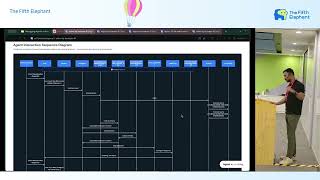
Anchor talk: Debugging Agents in Production
Rajesh Balamohan, Sachin Chaurasiya - Engineers at Isotopes AI
33 minutes19 June 2026

Anchor talk: ₹11 lakh/month: how we took the GPU out of Face Match
Vivek Kalyanarangan, Sr. Technical Architect, AI at IDfy
38 minutes19 June 2026
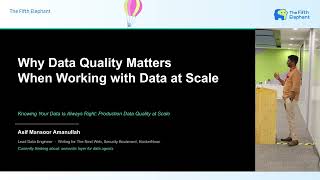
Lightning talk: Why data quality matters when working with data at scale
Asif Mansoor Amanullah, Lead Data Engineer at Apple
17 minutes19 June 2026
Venue
PhonePe
3rd Floor Training Room
Salarpuria Softzone, B Block, Bellandur
Bangalore - 560103
Karnataka, IN
Loading…
Hosted by
Jumpstart better data engineering and AI futures
Supported by
Venue host
PhonePe was founded in December 2015 and has emerged as India’s largest payments app, enabling digital inclusion for consumers and merchants alike.